Find a flat, armless chair on firm ground
When you take a pair of bongos outside, the chair you choose matters just as much as the drums themselves. Soft deckchairs, deep garden sofas, or chairs with high armrests push your elbows upward and force your wrists into an awkward bend. Instead, pick a simple wooden dining chair, a flat bench, or a sturdy folding stool placed on level paving or firm lawn.
Sit near the front third of the seat so your spine stands tall without leaning against a backrest. Your thighs should slope very slightly downward from hip to knee, with both feet resting flat on the ground about shoulder-width apart.
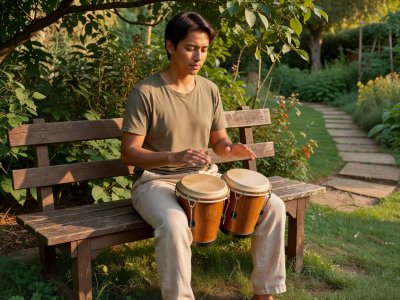 Seated Angle
Tilt the drums 15 degrees
Angle the top of the drums slightly forward, away from your stomach, so your fingers land flat on the skin without hitting the metal rim first.
 Strike Zone
Use the fleshy finger pads
Aim for the outer two inches of the drumhead using the soft pads between your fingertips and middle knuckles—never your bony joints.
Small drum left, large drum right
Every pair of bongos consists of two wooden or fibreglass shells joined by a solid wooden block called the bridge. The smaller drum is traditionally called the macho (usually 6 inches or 6.75 inches across) and produces a crisp, high voice. The larger drum is called the hembra (usually 7 inches or 8 inches across) and gives a deeper, warmer note.
If you are right-handed, place the smaller drum on your left side and the larger drum on your right side. Rest the bottom edge of the shells against the inside of your calves just below the knees, gripping the wooden centre block lightly between your inner knees. You do not need to squeeze hard—let the bottom rims rest against your shins so your legs carry the weight effortlessly.
Why beginners get sore knuckles (and how to prevent it)
Modern bongos typically come with one of two metal rim shapes: traditional flat hoops or curved "comfort rims" (such as LP Comfort Curve II or Meinl SSR rounded rims). Either way, the metal rim sits half an inch lower than the stretched drumhead. Beginners accidentally hit the metal when they hold the drums completely vertical and drop their whole palm straight down.
By tilting the drums slightly forward away from your torso, the top edge of the skin rises to meet the natural slope of your forearm. Keep your wrist level with the back of your hand, let your fingers curve naturally as if holding a tennis ball, and let only the top two joints of your index, middle, and ring fingers touch the skin.