Let the drum sing by bouncing right off
The Open Tone is the clearest, most melodic sound on both the small and large bongo. Think of the drumhead as a warm kitchen pan: you want to touch it briskly with the pads of your fingers and let your hand rebound upward immediately. If your fingers stay on the skin even a fraction of a second too long, the vibration stops and the note sounds flat.
Keep your index, middle, and ring fingers casually together. Aim for the outer ring of the drumhead—about two inches in from the edge—where the hide has the purest ring. Let the edge of the drum sit gently underneath your first knuckles as your finger pads strike and spring away.
TONE 02 // THE MUTED TONE (M)Press and rest for a dry, woody pulse
A Muted Tone uses the exact same part of your fingers as the Open Tone, with one simple change: instead of bouncing off, let your fingers stay resting on the skin until it is time for the next beat. This absorbs the ringing overtones and creates a short, dry "tock" sound.
Furthermore, when you hold your left-hand fingers or thumb lightly against the small drum while your right hand strikes an Open Tone beside it, the pressure slightly raises the pitch of the head. Alternating between pressed notes and open ringing notes is how players create conversation on a single drum.
TONE 03 // THE HEEL-TIP OR THUMB-FINGER ROCK (T / F)The secret to effortless timekeeping
In traditional Afro-Cuban rhythm workshops—from Havana courtyards to community drum circles—the left hand rarely lifts high into the air. Instead, it rocks gently back and forth like a seesaw on the small drum. First, drop the side of your thumb (or the soft heel of your palm) onto the head and leave it resting there. Next, pivot your fingertips down onto the skin while lifting your thumb up.
| Tone Name | Chart Symbol | Where to Strike | Finger Behaviour | Outdoor Volume |
|---|---|---|---|---|
| Open Tone | O | Outer 2 inches of head | Spring off immediately | Medium / Singing |
| Muted Tone | M | Slightly closer to centre | Rest flat on skin after tap | Low / Conversational |
| Thumb / Heel | T | Centre-left of small drum | Roll weight onto thumb pad | Very Quiet / Felt pulse |
| Soft Finger Tap | F | Outer edge of small drum | Drop fingertips as thumb lifts | Low / Crisp |
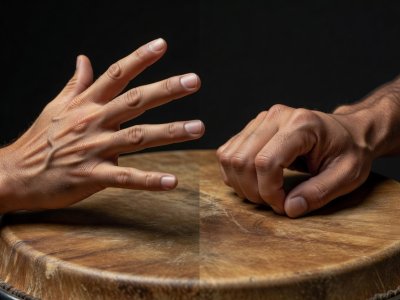 Rebound vs Rest
Watch your wrist height
Keep your wrist calm and let the small motion happen at the knuckle hinge. Big arm swings only tire you out and blur the rhythm.
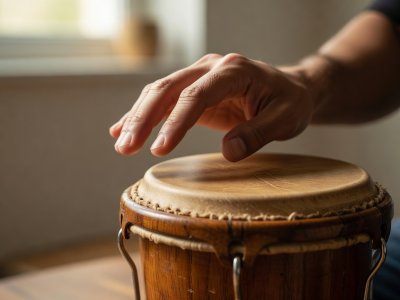 Gentle Accent
Save loud slaps for later
A sharp slap comes from whip-like finger speed, not brute force. Master clean open and muted notes first to protect your hands.